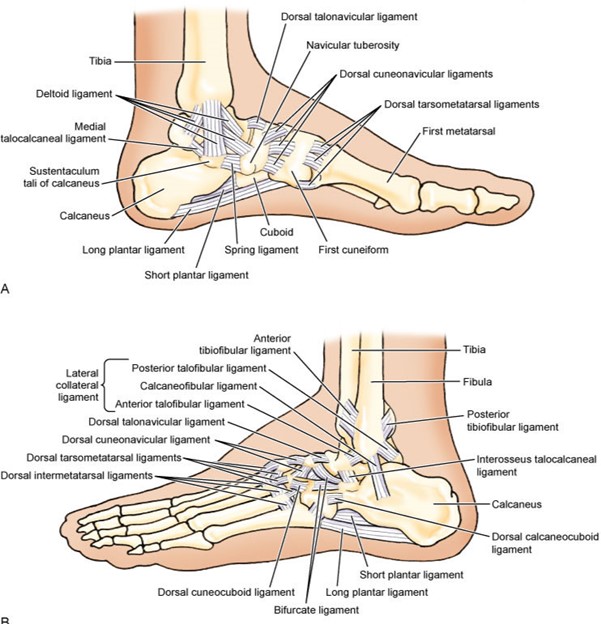
Definition:
Partial or complete tearing of the lateral ligaments of the ankle following forced inversion.
Pathophysiology:
Typically occurs when the ankle is suddenly “twisted” in a sports activity or by stepping off an uneven surface (usually involves inversion, plantar flexion & internal rotation forces at the ankle). Inversion sprains may also strain the fibularis (peronei) muscles as they try to resist the forces of the injury.
See grading scale on table below:
Grade | Description & Healing |
Grade I | • Mild swelling & point tenderness over ligament, no bruising |
Grade II | • Bruising visible on one side of ankle, mild to moderate swelling ligament & partial tears of calcaneofibular & posterior talofibular ligaments • Mild to moderate instability demonstrated |
Grade III | • Severe bruising & swelling on both sides of ankle • Complete tearing of multiple ligament & joint capsule; may also involve a ‘high’ (syndesmotic) ankle sprain where tibiofibular ligaments are involved • Unable to bear weight, almost complete loss of ROM |
Demographics
Incidence: very common ~45% of all sports injuries
Age: 10-30 yrs. peak (can occur at any age)
Gender: male = female
Risk factors:
- Prior ankle sprain (50% reoccurrence rate)
- Athletic activities involving running & cutting movements on high grip surfaces (soccer, basketball football)
- High foot arch (pes cavus)
- Poor landing technique
- Proprioceptive deficit (prior injury) or Joint Position Sense (JPS) decreases with fatigue
- Muscle imbalance (weak peronei muscles)
History
- Forceful trauma – twisting or ‘rolling’ of ankle, patient may hear a ‘popping’ sound or have sensation of tearing
- History of prior ankle sprains
- Limp after injury, with localized swelling
Physical
Inspection:
- Limp with swelling over lateral ankle
- Swelling bilateral (grade 2 or 3 – intracapsular) or one side (grade 1 – extracapsular)
- Possible bruising & ecchymosis
Palpation:
- Tenderness over anterior talofibular ligament
- If compression of distal tibia & fibula is painful may indicate distal interosseous ligament injury
- Difficult to palpate if substantial swelling
Motion:
- More limited ROM as severity increases
- Pain with Passive ROM into inversion
- Possible weakness/pain with peroneus (eversion) muscle contraction on RROM
- Peronei & retinaculae are often involved which can lead to decreased proprioception
Treatment
- Protect, rest, compress, cold-therapy and elevate the area
- Consider compressive wrap
- Consider crutches in more severe injuries
- Consider short-term use of lace-up brace; note that long term bracing does NOT show increased success & may even slow normal recovery
- Start Passive ROM ASAP!
- Reduce swelling & increase local fluid movement
- In chronic sprains with external scar tissue consider cross friction massage
- Short-term NSAID use
Rehabilitation Program
- Week 1: Passive ROM, ice after activity
- Week 2: Increase ROM, consider rocker board & theraband strengthening exercises
- Week 3: Continue exercises, consider adding inversion-eversion & limited side to side rocking
- Week 4+: as patient ability dictates progress to proprioceptive wobble board & sport activities
Prevention/Patient Education
- Avoid activities that cause pain or swelling
- Consider orthotic evaluation & use
- Address biomechanical technique issues
Prognosis
- Excellent for mild cases, early rehab. is key!!!
- Moderate to severe injuries may have residual lifestyle limiting symptoms for 6 – 18 months
- Early treatment minimizes chronic issues
- Chronic cases may be predisposed to degenerative joint disease